












Submenu section
The Motivation for Change Often Starts at Home- Even for US Senators
 0 Comments
**Senator Tom Harkin is the 2015 recipient of the Morton E. Ruderman Award in Inclusion, which recognizes an individual who has made an extraordinary contribution to the inclusion of people with disabilities in our society. Our foundation will honor Senator Harkin with a ceremony May 11, in Washington, DC, for his achievement in Congress and his continued work with the Harkin Institute.**
In recent years we have witnessed politicians describe how their views “evolved” on certain publicly contentious issues. From stem cell research to drug policy to LGBT rights, many of our nation’s leaders- on both sides of the aisle- have changed their endorsement and voting patterns because of said evolution. While some, no doubt, have done so for political expediency (aka flip-flopping), others have done so from a place of genuine empathy. Empathy, as Merriam-Webster defines it, is the action of understanding, being aware of, being sensitive to, and vicariously experiencing the feelings, thoughts, and experience of another… And this emotion, more often than not, begins with someone close to home.

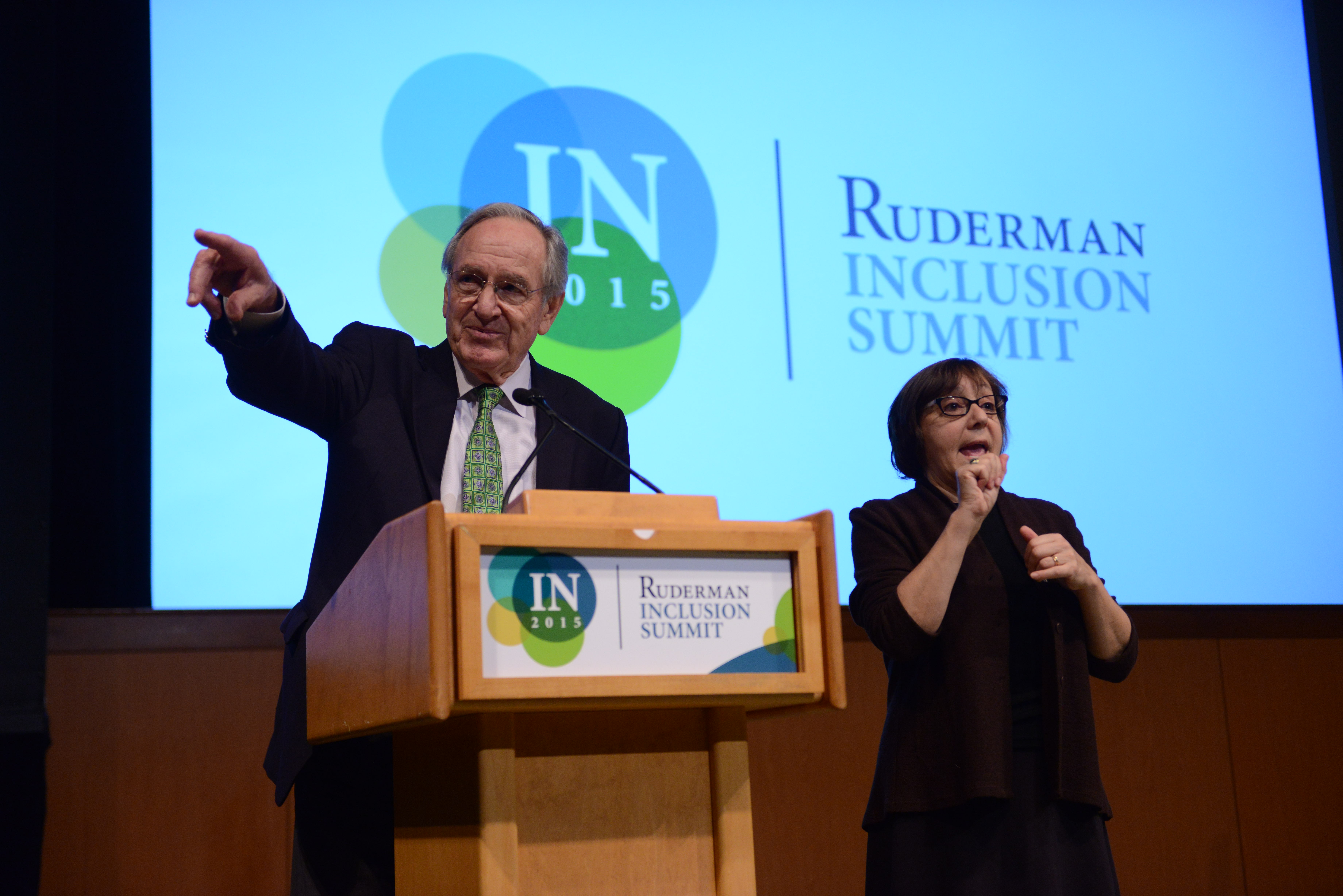
Senator Tom Harkin addresses the 2015 Ruderman Inclusion Summit in Boston
That was certainly the case for Tom Harkin. The 76-year-old retired United States senator from Iowa knows firsthand about the challenges people with disabilities face, beginning with his own family. Raised in Cumming, IA, by a coal miner father and a Slovenian immigrant mother, Harkin explains, “[my late brother Frank] was profoundly deaf. I saw how he had been discriminated against in education and the workforce and how there were so many barriers to his full participation in society.” He even described to me how his brother was taken from their family home and moved to a boarding house for the deaf without being told, without understanding what was happening to him.
Elected to the House of Representatives in 1975, then Rep. Harkin began focusing on issues dealing with deafness, working to establish decoding devices at the National Captioning Institute to caption programs in the late ’70s and early ’80s. At that point he realized the issue of disability inclusion was broader than just deafness courtesy of another family member- his nephew Kelly. The son of his sister, Kelly had been severely injured while serving in the military and became a paraplegic. Following his discharge, “he wanted to go to college and use his GI bill,” Harkin said, “and he couldn’t take classes because classes were on the second floor and there wasn’t any elevator.” Kelly’s mobility problems, even with the use of a wheelchair highlighted the grave accessibility problems Harkin would fight to remedy through landmark legislation- the Americans With Disabilities Act of 1990 (ADA).
Reflecting on the passage of the bill, Harkin tells me something quite contrary to the present-day partisan divide that we’ve come to reluctantly accept as the natural business of the Beltway. The biggest obstacle to passing the ADA interestingly did not come from the GOP, but rather the multitude of disability advocacy groups themselves. “A lot of people are surprised when I say this. The hardest part was getting all the disability groups to agree on one bill,” said Harkin, but admitting, “You can kind of understand [because] in the past each disability group had their own little sector- whether it was blind or deaf… all these different groups, paraplegics, others- and it was just hard for them to agree on a broad civil rights bill. But we got it done.”
Hindsight being 20-20, when I ask Harkin if given the opportunity to go back and do something different in passing the bill, he paused. “Quite frankly I think the area that I would have liked to work on more, and it’s the one area I’m focusing on now with the Harkin Institute, is employment,” he says with a touch of remorse. “There are four pillars- four goals, I should say, of the ADA: full participation, equal opportunity, independent living, economic self-sufficiency.”
Offering a progress breakdown of each goal, the one he says the legislation has not dented in any significant way is jobs and employment. “I wish we had perhaps done a little more in that area in the bill itself, setting up goals to meet in certain years in terms of employment and employment training opportunities. Now it may have been hard to do at the time, but I wish we paid more attention to that. I think we were paying more attention to the physical barriers, transportation, but I wish we had focused on more tangible metrics on employment.” This is perhaps rightfully so. As of April 2016, the unemployment rate for people with disabilities is 70 percent, compared to 5 percent nationally.
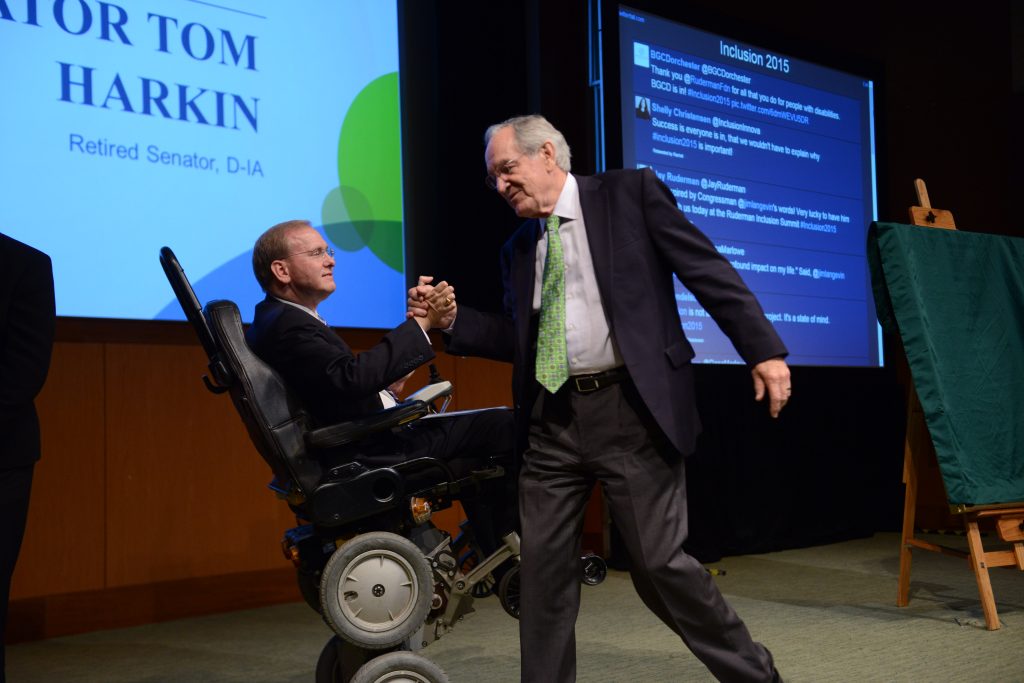
Senator Tom Harkin (right) shaking hands with Rep. James Langevin (D-RI) at the 2015 Ruderman Inclusion Summit in Boston
As I ask him to examine how the present digital industrial revolution could offer new employment opportunities for people with disabilities, Harkin tells me, “The revolution in IT (information technology) has opened so many doors for people with disabilities. For example, we have online video interpretation services now that are so good that those who are deaf and those who are hearing can be on a conference call and communicate simultaneously almost,” a true model of inclusionary technology.
However, when I inquired if he felt any specific industries may present an advantageous opportunity to people with disabilities, he said definitively, “No industry or profession should be exempt and I’ve always been careful not to perpetuate some misconceptions that people with disabilities are good at ‘X’ skills or ‘Y’ skills, but not good at ‘W’ skills. People with disabilities are just like everyone else. Skills vary.” Instead he focused on the fact that there are many industries in need of workers but there hasn’t been enough done for outreach to bring them into the workforce. There’s a demand and a supply, but what’s missing is the method to connect them. Sadly many tend to think of jobs for people with disabilities as low level jobs, and this could be interfering with the connection, but he suggests progress can and will eventually be made as we reevaluate their place within these growth professions.
As our conversation came to a close, I asked Harkin, beyond his familial connection to the issue, how he would sum up his decision to dedicate his professional life- even after leaving Congress- to fighting for people with disabilities and inclusion. His response, rather poetically and in the spirit of American liberty: I believe in the maximum freedom for individual thought and inquiry and personal choices, within broadly accepted ethical boundaries, and in a society without physical or attitudinal barriers to one’s full participation in our economic and social life.
Great words from a great man.
About the author Justin Ellis is the Social Media Coordinator of the Ruderman Family Foundation who was first connected to the issue of disability through his sister, an award-winning special education teacher. Outside the Foundation he is an avid lover of Middle Eastern history and communication psychology.
Stay Included
To stay up to date on our most recent advocacy efforts, events and exciting developments, subscribe to our newsletter and blog!