













Submenu section

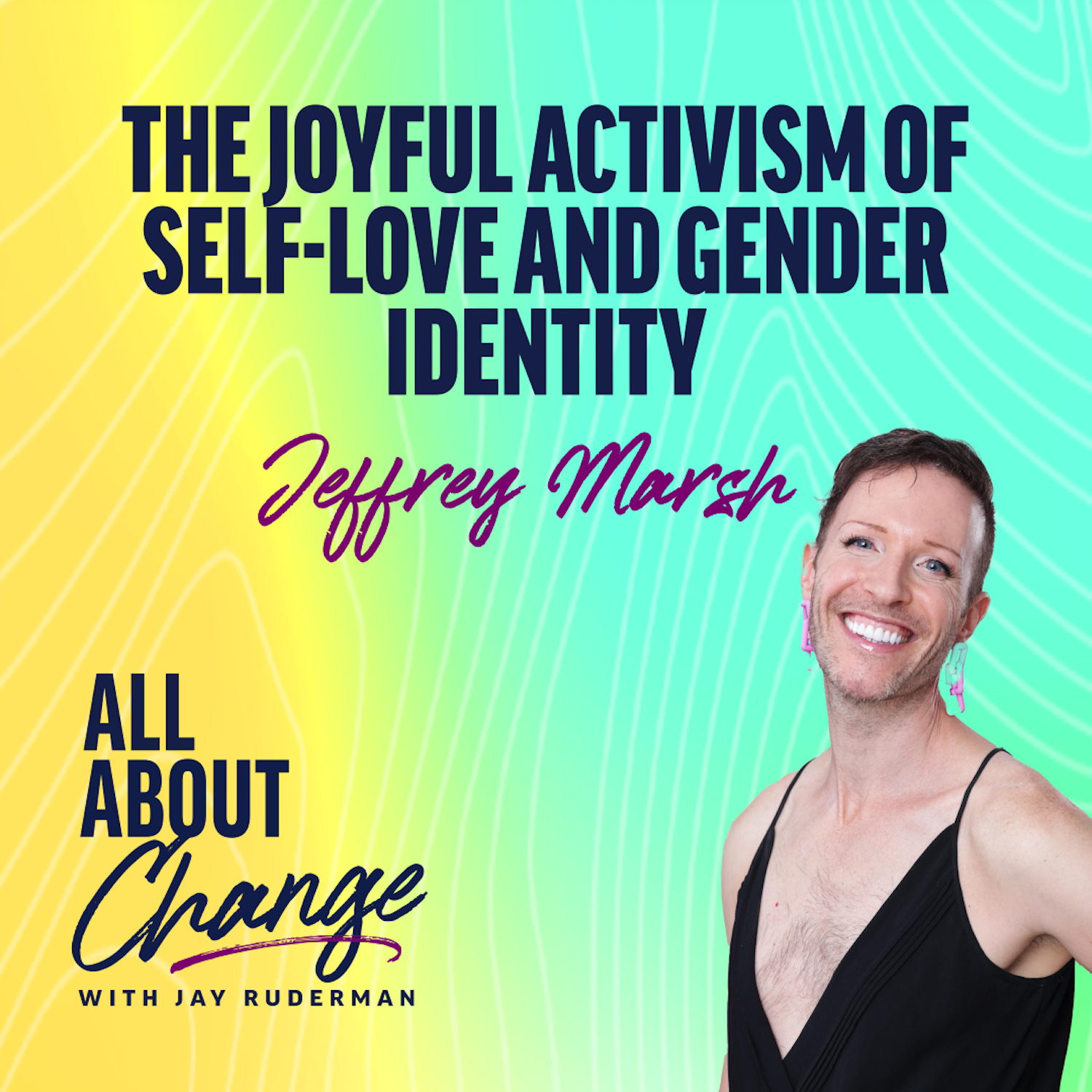
Jeffrey Marsh: The Joyful Activism of Self-Love and Gender Identity
For nearly two decades Jeffrey Marsh has been a representative and advocate for LGBTQ people of all stripes. Whether on Vine, Tik Tok or Instagram, Jeffrey has built success on simple videos helping straight and LGBTQ people attain a lasting sense of peace and self-compassion.
Jeffrey is the first non-binary person to sign a book deal with any “Big 5” publisher worldwide, and they have since written two books, “How to Be You: Stop Trying to Be Someone Else and Start Living Your Life” and “Take Your Own Advice: Learn to Trust Your Inner Voice and Start Helping Yourself.”
Jay and Jeffrey explore the anxiety in wanting to do right by other people, the different valences of Jeffrey’s advice to the LGBTQ community and much more.
TRANSCRIPTION
Jay Ruderman:
Welcome to All About Change. Hey, All About Change listeners. It’s Jay here, and I wanted to tell you about my book, Find Your Fight, is now available in 800 Walmart stores. In the book, I talk about my biggest successes and those of others, and also failures as an activist, and my personal philosophy on how to make a difference. It’s the perfect gift for friends and family who care about making a positive change in our society.
My guest today is Jeffrey Marsh. For nearly two decades, Jeffrey has been a representative and advocate for LGBTQ people of all stripes, whether on Vine, TikTok, or Instagram. Jeffrey has built success on simple videos helping straight and LGBTQ people attain a lasting sense of peace and self-compassion. Jeffrey is the first non-binary person to sign a book deal with any Big Five publisher worldwide, and they have since written two books, How to Be You, and Take Your Own Advice.
Jeffrey Marsh, welcome to All About Change.
Jeffrey Marsh:
Hi, how are you doing?
Jay Ruderman:
I am good. I’m good. As I told you before we got onto camera, I’m a little bit nervous because I don’t want to make a mistake. I am a bit older than you and I’m learning a lot of new things about gender and respect and how to correctly address people. So if I make a mistake, call me out on it. But if you have any words of wisdom, I would love to learn from you.
Jeffrey Marsh:
Let’s start breaking it down spiritually. So what does nervous feel like?
Jay Ruderman:
That I don’t want to be disrespectful, that I’m a little bit tense because I’m all about respect, I believe that that is core to advocacy. That if you’re going to be effective, you have to respect people that you’re speaking to.
Jeffrey Marsh:
So you told me what you’re thinking. What does it feel like? Where is nervous in your body? What’s the muscles? What’s the quality of the physical aspect?
Jay Ruderman:
Oh, I think shortness of breath, mind racing. Actually, before we came on camera, before you came on, I was practicing some of your breathing techniques. Breathing in, holding it, holding the breath in, letting the breath out, holding it as a way of doing a little mini meditation before we began.
Jeffrey Marsh:
So you were already beautifully mentoring yourself.
Jay Ruderman:
I was following your advice.
Jeffrey Marsh:
Well, hey, a tiny story. I went on Newsmax and that was a little … There were some physical body sensations going on while I was sitting there. And before the camera was about to turn on, I’m saying to myself inside my head, “I love you. I’m glad you’re here. Thanks for doing this.” So you had a chance to have a mini meditation for yourself.
Jay Ruderman:
I did. I did, yes.
Jeffrey Marsh:
My teacher at the monastery would always say, “Feelings make things real.” So I wanted to talk about the feelings first because me having anything going about whether you call me the right pronouns or whatever, that’s a completely separate issue, and I don’t have anything going about that. And what happens afterwards is very different than a story about what might happen. And we should be very kind to ourselves when we recognize that there’s a story about what might happen and what we might do wrong and how we might prove that we’re a bad person. All of that stuff is stuff we don’t have to live with.
Jay Ruderman:
Yes. And I think that I … Not to make this all about me because we’re going to talk about you. But I can attempt to be a perfectionist and I think that sometimes gets in the way.
Jeffrey Marsh:
Yes. There’s a sequence that I’m working with in the people, I do workshops and coaching and that sort of thing. And there’s just this paradigm that I’ve seen very differently now. I want to be safe, so I try to do what’s perfect so that people will be pleased and so that I won’t be abandoned. A four-part process that stacks all the way up on itself, and I’m not sure any of it’s true. I can answer that one. None of it’s true. Isn’t that interesting? It guides a lot of our lives sometimes. Can I say thanks for being a good dad?
Jay Ruderman:
Well, I hope I am. I hope I am. I have four children. And I do want to talk to you about this because you’ve talked about your parents and a separation and the reason for the separation. And that really, really scared me because I love my children and I want to have a relationship with them.
Jeffrey Marsh:
And that’s what scares you most. I don’t know what’s going on for you internally, but you had made a few comments throughout as you were talking about something so frightening, so painful, the loss of perhaps your relationship with your child, if not their safety. Which is so scary. And then a kind of running commentary that, well, things are going to be how they’re going to be, which is fundamentally true and, my goodness, can we just sit with a frightening pain for a little bit? Because philosophically, yeah, things will turn out how they turn out. True. And it’s okay to have a lot of complicated feelings about that dynamic and that relationship.
Jay Ruderman:
Don’t I know it? Been living that for a while.
Jeffrey Marsh:
Yeah. And so you asked me about my biography and some of the reasons why I made the decision I made. It’s been years since I’ve spoken to anyone in the family. I haven’t spoken to a cousin, a family friend, or anybody connected with the family for years now. And the reason that I, on TikTok, we say, “Go no contact.” The reason I went no contact is that it wasn’t healthy and it wasn’t healthy for me. I actually would be open to it changing in the future. I think currently it’s still not healthy or wouldn’t be.
But one thing I realized recently is that I was attempting to set boundaries with my parents, for example. But as far as I could tell, they had already set a boundary with me, and that was that they weren’t willing to go certain places that I needed to go to talk about to heal for myself.
Jay Ruderman:
I get that. I’m wondering if I could ask you something about your activism, because from the outside, you’ve been remarkably consistent in your message for decades now.
Jeffrey Marsh:
Yes. Correct. Go on.
Jay Ruderman:
And how would you say that your work advocating for LGBTQ people has changed over the duration of your activism?
Jeffrey Marsh:
Generally as an arc. So did you Google around and look at any of my old Vines? Speaking-
Jay Ruderman:
I didn’t see the Vines, but the Instagram, yes.
Jeffrey Marsh:
Yes. There was a time when people didn’t know what non-binary was, for example. And so there was a lot of educational, there was an educational aspect to it, and that still happens actually to a certain extent. But there’s … How do I phrase this? Demonizing us for power and votes is very different than I don’t know what I’m looking at, neither of which are very cute to deal with, but one is sure a lot more devious and immoral and hard to be around.
Jay Ruderman:
I quite don’t understand the demonizing others who are different. I remember, this is going to sound very corny, but when I grew up, there was a song which you may know of, and I don’t know who sings it, but I am who I am and with no excuses. Do you know who sings that song?
Jeffrey Marsh:
It is from the lyrics are Harvey Fierstein and the music is … It’ll come to me. It’s from La Cage aux Folles.
Jay Ruderman:
Yes.
Jeffrey Marsh:
So many actors have sung it, but yeah.
Jay Ruderman:
Exactly. But I love that song. I love that song for the meaning of it because I was just like, what the hell? Whoever you are, whoever you choose to be, why do we as a people, as a society, demonize others? Just because they’re different, they’re not a threat to us. Why do we do that? I mean, it’s exacerbated in the world that we live in right now. In my lifetime, it’s worse than it’s ever been. Why do we do that to people?
Jeffrey Marsh:
Well, there’s a practical answer. There’s a philosophical answer. Let’s cover them all. But the first response is, I personally will never understand. I think you and I are quite a lot alike in that way, a very Mr. Rogers approach that I could never understand the level of delight and cruelty that we’ve seen, especially recently. It just was a … I’ll let you speak for yourself, but to me, it was just a shock to my system that it could rise to the levels that it’s currently at. And I know that there are many times throughout human history where demonizing others has been the vogue, but to be living through one of those times is really heavy.
I do think phobias, transphobia, homophobia, is a version of jealousy, a version of envy, and I represent, I hope, a level of freedom and self-kindness that if people are too scared to try on their own, they’d rather blame me. They’d rather blame us, the messengers.
Again, to truly compliment you, I just desperately don’t want anyone to turn to a self-judgment, self-hate, or a self-judgment process for using the wrong word or saying the wrong thing, or having a frank discussion with me about how I’d like to be referred to and the correct, proper, respectful way to refer to people like me. I would prefer that all of that happens with no self-hate for anybody. And I made a vow a long time ago that I would talk to people about it and do everything I can to make sure nobody felt bad talking to me about it.
Jay Ruderman:
My belief basically is that most people are good and that if you speak to people and you advocate for justice, most people, and most Americans, because most of the people I’m in touch with are Americans, respect justice and want fairness. That’s sort of a bedrock principle. And I don’t know how you feel about that, but I feel like with all of the noise and all of the hatred and everything that’s going out there, it’s not everyone. Most people, I don’t think believe that stuff. It’s just the people who are the loudest who may be saying it.
Jeffrey Marsh:
Oh, yes. I agree 100%. You made me think of a few things. So to me, there’s been a ton of surveys. I’m trans, I’m non-binary, and we’re about trans people in general, it depends on the survey, but we’re about 0.7% of the population, less than 1% usually. And in survey after survey, most people don’t spend a lot of their day thinking about us, which I think is great. I mean, I think it’s fine. In general, the surveys show people are like, “Let people be people. It’s not really that much my business and I don’t think about it that much.” That’s most of the country.
And then there’s a segment that tries to use who we are for gain, as I suggested earlier. And I think that’s a really risky spot for them because it takes a toll on them to be doing it. The Buddha talked about anger being like picking up a coal from a fire and throwing it at someone. You might hit them, but you’ve sustained the most damage. And that’s not that anger is a bad thing, it’s just that harboring ill will toward a group of people you don’t even know must be extremely heavy stuff, I would imagine.
Jay Ruderman:
I think so. And also, if you’re talking about .7% of the population, then our goal as Americans or as world citizens should be to protect that minority and to say, “You’re part of our society, you’re a vulnerable part of our society because your numbers are small and we should be into protecting you and not making you feel more uncomfortable or attacking you.” And our leadership should be out in front because they’re supposed to be leaders.
Unfortunately, I think our system is broken. I think our system of leadership is broken. I think it’s about money and I think it’s about division and I think it’s about making money over division. It’s just not what I think this country was supposed to be about. I don’t know how it’s fixed. I really don’t because I don’t see any change. But wow, it’s not great.
Jeffrey Marsh:
I’m going to strike a hopeful tone, if you’ll permit me.
Jay Ruderman:
Please. Please.
Jeffrey Marsh:
Because I see this immense two things sprung to mind. Well, actually three things, but I’ll try to get to them all briefly. Number one, most of the trans people I know are like, “Well, F it. I’m just going to do what my mission in life is.” Speaking of your book, right? They’re like, “Oh, this hemming and hawing, this should I, shouldn’t I? Could I step into a leadership position?” All of that is wiped completely away. And I see so many activists, just LGBTQ in general, being themselves, writing their book, speaking out and it is incredibly inspiring. And the second thing that you helped me to see just now, I see so many people working person to person in their real lives, in their actual community where they live, and that gives me hope.
Jay Ruderman:
So I see you working in two paths. First, you stand as an example of what can be on your own personal journey. And then you advocate for this sort of internal activism where you try to help people advocate for themselves and to themselves so they can be happy in their bodies and in their lives. Can you talk to me about the Venn diagram of these projects and where they intersect and where maybe they’re separate projects?
Jeffrey Marsh:
No, I love talking about them as the … By the way, kudos for dropping a reference to Venn diagrams, is one of my favorite things in the world. Yeah, the center of the diagram is that the … So I have spent 25 years studying Zen Buddhism. I lived at a monastery for a while, for years actually off and on. I used to feel like, well, there’s the spiritual and then there’s the every day. There’s the philosophical and high-minded, and then there’s the actual and practical.
And then I realized, oh my goodness, all of it’s non-binary. All of it’s smooshed. I have to show … To me, the greatest opportunity for the platform I have is to show all the fully human aspects of what it’s like to be someone like me. And that can’t be this curated, I’ve got it all figured out, whatever, energy. And so I think it’s showing some of the seams, some of the messiness, some of the emotion, all of that is not just fair game, but really important to show.
Jay Ruderman:
I’ve heard you talk about what you do and how much of it is for your younger self, and how much of it is for people like yourself who may be going through some very difficult times right now, and who you serve as a role model or as an example of how they can help themselves and not get into a dangerous space. Is it both?
Jeffrey Marsh:
What would your answer be? That’s the ultimate Zen thing, by the way. What do you see, Jay?
Jay Ruderman:
I do think it’s both. I mean, I think that as an activist, I look outside a lot and I look at what impact am I making in the world, but I also think that it’s about me also and thinking about what did I want as a young person and who did I want to become? And how did that fit in with my family and expectations? And it’s all sort of woven together. And I don’t know if I’ve ever done as much work as maybe you have done spending the time in the zen monastery to try to feel like I completely understand this or I understand it better. I don’t know if I understand it. I’m just doing it. I’m just going forward and doing it. But I do talk to my psychiatrist and he tries to talk about me as a child and so forth and relationship with people in my family. And so I am delving into that also.
Jeffrey Marsh:
Great. I’ll give you a little hot tip or fun story. I thought for years, I’m mentoring my inner child and I’m going to raise my inner child the way I never got raised and all this sort of the framing of what’s generally talked about in Western therapy. And one day I had a huge enlightenment experience because my inner child was saving me. Little Jeffrey was the one who remembered how to have joy, how to have fun, how to play, how to be present, how to get out from under the heaviness. And so I realized it was very much a two-way street and we love each other and take care of each other. And gosh, it’s good to feel young again sometimes in a heavy world.
Jay Ruderman:
That I think is sometimes missing in life. I think that the joy that we experienced as children over simple things in time saps away from us.
Jeffrey Marsh:
Whoa. Yeah.
Jay Ruderman:
And we don’t experience it and we try to … We all want it. We all want that joy back in our lives. We want to feel that joy and we don’t know how to get there. And we go to … I mean, people go to drugs, they go to sex, they go to alcohol, they go to any number of different things to try to find it, and they’re empty. And I know that you’ve talked about experiencing that and we find out. We find out that they’re empty. And I think we have to get back to a place, which I think that you’ve done a great job at, of finding a way to lead a joyful life. And I love that about you. I mean, I respect that. I wish I could be where you were or where you are.
Jeffrey Marsh:
We do study, it was a big part of my experience at the monastery to look at projection. And this would be a Buddhist saying, “We are all one. That the joy you see in me is something you wouldn’t even know to want unless it was in there somewhere, in you, somewhere.” With that realization, it’s just a matter of practice. And we talked about how our inner child, whatever that concept is for someone, can help us remember and come back to it. There is nothing more angering … Oh, I’m going to make a bold statement. You ready? There’s nothing more angering to the hateful people that hate me a lot than that I’m joyful. It is not just that I’m an out LGBTQ, I look this way, I have a beard and eyeshadow, I’m trans, non-binary, all the things. It’s not just that. It’s that I’m happy. I love myself, love this person, truly do all the time.
Jay Ruderman:
And that makes them mad.
Jeffrey Marsh:
Yeah. That makes them angry because there are a lot of folks who with a lot of trauma who are LGBTQ, and it leads to a lot of self-hate. There are a lot of cis and straight people with a lot of self-hate. So there are a lot of folks who are self-deprecating, who are down on themselves, who do not love themselves, who thoroughly hate themselves. And that doesn’t seem to trigger folks as much as someone who is the moment you become joyful and self-kind and self-loving, you will have opposition. I wish it wasn’t that way, but it comes with that territory.
Jay Ruderman:
I have lots to think about.
Jeffrey Marsh:
Yeah. And the good, good news is who cares about them? You’re joyful.
Jay Ruderman:
So there’s an interesting paradox in your work. I noticed your books are labeled as self-help and they’ve achieved a great deal of success in that category. But so much of the challenges that LBGTQ people face, young or not, are external. “My friends don’t understand me. My parents are bigoted. The government, my country doesn’t support my rights.” How do you help people reconcile this internal work with the knowledge that the biggest challenges with being queer often have nothing to do with you?
Jeffrey Marsh:
Oh, what a delicious question. I look at it as a form of taking responsibility. That, in a sense, the hatred buck is going to stop here with me, with Jeffrey. So we get a lot of opposition, we get a lot of hate, we get a lot of BS, we get a lot of people’s issues thrown onto us. We get a lot, a lot, a lot, a lot. And at the end of the day, I’m a being of love, I’m involved in a process of love, there is love here, and that is what I’m practicing. So in a sense, the answer to your question is it doesn’t matter if there’s an imbalance. It doesn’t matter if the outside world is in a different place than we are. At the end of the day, I’m with me.
Jay Ruderman:
So Jeffrey, I really want to thank you for your time. I will tell you, I’ve learned so much from you. That means a lot to me. And the fact that you took a concern for me on a personal level as we started out in this conversation, it just touched me very, very deeply. So I really want to thank you.
Jeffrey Marsh:
Oh, well, I like you. I mean, I like humans in general, but I really felt it was partly selfish. I knew that you talking about it would inspire me, so that’s number one. But I also knew it would inspire everybody listening because it’s such a human path to care deeply about others and want to love and respect human beings. Imagine in 2025.
Jay Ruderman:
It’s what it’s all about.
Jeffrey Marsh:
What it’s all about. Let’s keep doing it. Let’s keep going.
Jay Ruderman:
Jeffrey Marsh, thank you so much for being my guests on All About Change. I wish you to go from strength to strength.
Jeffrey Marsh:
Thank you. I will take strength from good people like you doing the good work. So thank you.
Jay Ruderman:
Thank you for being part of the All About Change community. We aim to spark ideas for personal activism, helping you find your pathway to action beyond awareness. So thank you for investing your time with us, learning and thinking about how just one person can make the choice to build a community and improve our world. I believe in the empower of informed people like you to drive real change, and I know that what we explored today will be a tool for you in that effort.
All right. I’ll see you in two weeks for our next conversation, but just one small ask. Please hit subscribe and leave us a comment below. It lets us know that you value this content and it supports our mission to widely share these perspectives. If you’re looking for more inspiration, check out this next video. I chose it for you and I know you’re going to enjoy it.
I’m Jay Ruderman. Let’s continue working towards meaningful change together.
Today’s episode was produced by Tani Levitt and Mijon Zulu. To check out more episodes or to learn more about the show, you can visit our website Allaboutchangepodcast.com. If you like our show, spread the word, tell a friend or family member, or leave us a review on your favorite podcasting app. We really appreciate it. All About Change is produced by the Ruderman Family Foundation.
Stay Included
To stay up to date on our most recent advocacy efforts, events and exciting developments, subscribe to our newsletter and blog!